





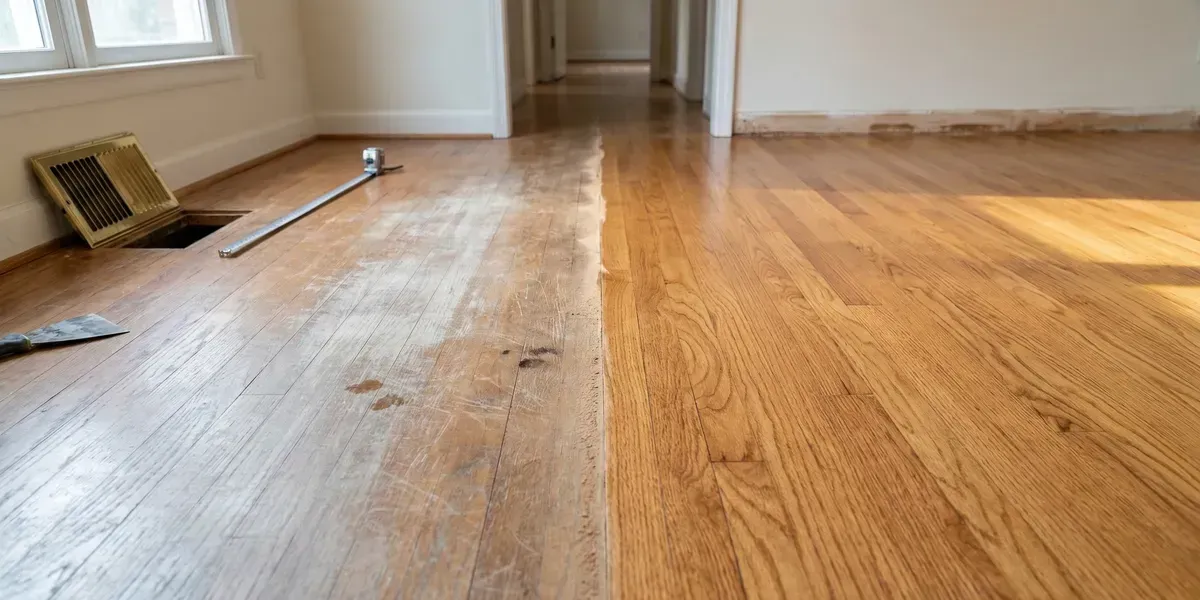
When to Refinish vs. Replace Your Hardwood Floors
You know your hardwood floors need work, but the big question is: can they be refinished, or is it time for a full replacement? The answer depends on the wood's thickness, the type and extent of damage, and your budget. Here's a practical framework to help you make the right call.
The Thickness Test: Can Your Floors Be Sanded Again?
Every refinishing involves sanding off the old finish and a thin layer of wood. Standard 3/4-inch solid hardwood can typically handle 4 to 6 refinishings over its lifetime. The question is whether your floors have enough wood left.
How to check:
- Remove a floor register or threshold to see the board's profile from the side
- Measure the wood above the tongue (the interlocking part). You need at least 1/4 inch above the tongue for a safe refinishing.
- If you can see the tongue or nails from the surface in any spots, the floor has been sanded too many times
Engineered hardwood has a thinner wear layer (typically 1 to 6 mm) and can usually only be refinished once or twice. Check the manufacturer's specifications if possible.
If your floors pass the thickness test, refinishing, including sanding, custom staining, and protective finish coats, is almost always the better option financially and aesthetically.
Assessing the Damage
Not all damage is created equal. Some issues are purely cosmetic and easily addressed by refinishing. Others go deeper and may require board replacement or full floor replacement.
Refinishable Damage (Surface Level)
- Scratches and scuff marks: Even deep scratches that catch your fingernail can be sanded out during hardwood sanding.
- Dull or worn finish: The most common reason for refinishing. The wood underneath is usually fine.
- Minor staining: Most surface stains from spills come out with sanding. Dark water rings from plant pots may need deeper sanding but are usually treatable.
- Small gaps between boards: Normal seasonal movement in Atlanta's climate. Gaps up to 1/8 inch are cosmetic and don't require action. Larger gaps can be filled during refinishing.
- Worn-through finish in traffic areas: Common in hallways and kitchen entries of older homes. Refinishing restores protection before the exposed wood sustains real damage.
Damage That May Require Board Replacement
- Water staining that penetrates the wood: Deep black stains from prolonged water exposure (leaky pipes, pet urine over time) may not sand out completely. Individual boards can be replaced and blended in during refinishing.
- Cupping or crowning: Boards that are warped from moisture usually need to dry out first. If the warping resolves, refinishing works. If boards are permanently deformed, they need replacement.
- Localized rot or soft spots: Damaged boards can be cut out and replaced. If the damage is in a small area, board repair combined with refinishing is the cost-effective solution.
Damage That Usually Means Replacement
- Widespread water damage: If more than 30% of the floor shows deep water staining, warping, or delamination, replacement is usually more practical than trying to repair board by board.
- Structural issues: Sagging, bouncing, or significantly uneven floors indicate subfloor problems that need to be addressed before new flooring goes down.
- Termite damage: Even if the surface looks okay, termite damage weakens the wood internally. Tap suspect areas; hollow sounds mean the wood is compromised.
- Floors sanded to the limit: If you can see nail heads or tongues, or if previous refinishings have made the floor noticeably thinner, replacement is the only option.
Cost Comparison
The financial difference between refinishing and replacing is significant:
- Refinishing: $3 to $8 per square foot in the Atlanta area (see our full refinishing cost guide)
- Replacing: $8 to $15+ per square foot for new hardwood, installed
For a 1,000-square-foot project, that's the difference between $3,000 to $8,000 for refinishing versus $8,000 to $15,000+ for replacement. Refinishing also takes less time (2 to 5 days versus 5 to 10 days for a full replacement) and creates less disruption.
Even if you need to replace some boards during refinishing (which adds $10 to $20 per board), the total cost is still well below full replacement in most cases.
Common Scenarios in Older Atlanta Homes
We see a lot of hardwood floors in the Atlanta metro area, and certain patterns come up regularly:
1960s Original Oak (Buckhead, Decatur, East Cobb)
Many mid-century homes in Decatur and surrounding areas have original red oak strip flooring. These floors are typically 3/4-inch solid oak and have been refinished 1 to 3 times. Most have plenty of wood left for another refinishing. Common issues are worn finish in hallways, kitchen scratches, and some pet damage. Verdict: Refinish.
1990s Builder-Grade Oak
Homes built in the 1990s boom often have 3/4-inch #2 common oak. These floors may have more knots and color variation than premium grades. They've usually only been refinished once or twice. If the wear is mostly cosmetic, refinishing is straightforward. Verdict: Refinish.
Worn-Through Finish in High-Traffic Areas
This is the most common scenario we see. The floor is generally in good shape, but hallways, entries, and the path between the kitchen and living room have worn completely through the finish to bare wood. If the bare wood hasn't been damaged by moisture or deep scratching, a full sand and refinish brings the entire floor back to uniform condition. A screen and recoat won't work here since you need to sand down to bare wood in the worn areas. Verdict: Refinish.
Pet Damage with Urine Staining
Pet urine that's been cleaned up promptly usually only stains the finish. Prolonged exposure causes the wood to turn black. If the black staining is limited to a few spots, board replacement during refinishing works well. If large areas are affected (a whole room, for example), the smell may have reached the subfloor, and replacement might be necessary. Verdict: Refinish if localized; replace if widespread.
Water-Damaged Areas Near Bathrooms or Kitchens
Slow leaks from dishwashers, washing machines, and bathroom plumbing are the biggest threats to Atlanta hardwood floors. Check for soft spots by pressing with your foot. If the damage is within 2 to 3 feet of the source and the rest of the floor is solid, board replacement and refinishing is the way to go. Verdict: Repair and refinish if limited to one area; replace if damage is widespread.
Making Your Decision
Here's a simple decision tree:
- Is there enough wood thickness? If no, replace. If yes, continue.
- Is the damage cosmetic (scratches, worn finish, minor stains)? If yes, refinish.
- Is the damage structural (rot, widespread warping, termites)? If yes, replace.
- Is the damage localized (a few bad boards, one water-damaged area)? If yes, repair and refinish.
When in doubt, get a professional assessment. An experienced flooring contractor can check wood thickness, evaluate damage extent, and give you honest advice on whether refinishing will achieve the results you want. Request a free estimate from our team and we'll assess your floors in person. We serve homeowners in Roswell, Decatur, and throughout the Atlanta metro.